
The Velocity Trap: Why Moving Fast Is Making You Slower

By Nadir Ahmad, CEO at Dowling Street
Every leader I know is sprinting. Racing to adopt AI. Rushing to transform. Scrambling to stay ahead. And yet, when you look at the actual results, most of them are running in circles.
MIT's recent study dropped a bombshell: 95% of generative AI pilots are failing to deliver measurable value. Not struggling. Not underperforming. Failing. Despite $30-40 billion in enterprise investment, nearly all organizations are seeing zero return on their AI initiatives.
That's not an AI problem. That's a velocity problem.
The same pattern shows up everywhere. Boston Consulting Group found that 42% of companies abandoned most AI projects in 2025, up from just 17% the year before. The faster companies move to adopt, the faster they fail. Meanwhile, the organizations actually succeeding with AI are doing something counterintuitive: they're pursuing half as many opportunities as their struggling peers.
This isn't about AI. AI just happens to be the latest and most expensive way to demonstrate a dysfunction that's been festering for years. We've become addicted to velocity, mistaking motion for progress, activity for achievement, and speed for wisdom.
The Speed Delusion
There's a neurological reason why velocity feels good even when it's destroying value. Every time you launch a new initiative, attend another meeting, or check another item off your list, your brain releases a small hit of dopamine. The same neurotransmitter that drives addiction is the one making you feel productive when you're actually just busy.
Dr. Robert Sapolsky's research on decision-making under stress reveals why this matters: when we operate at high velocity, our brains shift into what he calls "emergency mode." The prefrontal cortex, responsible for strategic thinking and complex judgment, gets overridden by more primitive neural circuits designed for immediate action. We become faster, but we also become stupider.
This explains why the AI adoption frenzy looks the way it does. Companies see competitors moving and feel the urgency to act. That urgency triggers emergency mode. Emergency mode demands visible action. Visible action gets rewarded with dopamine and board approval. And the cycle accelerates, even as the results deteriorate.
The math is brutal: only 26% of companies have developed the capabilities to move AI beyond proof-of-concept to tangible value. The other 74% are stuck in what I call "performative transformation," where looking like you're changing matters more than actually changing anything.
What Speed Actually Costs You
Let's be specific about what velocity destroys.
First, speed kills decision quality. When MIT researchers dug into why 95% of AI pilots fail, they didn't find technical problems. They found strategic ones. Companies were implementing AI before they understood what problems they were trying to solve. One executive admitted: "We said, 'Step one: we're going to use large language models. Step two: What should we use them for?'"
That's not a technology failure. That's a judgment failure caused by moving too fast to think.
Second, speed prevents organizational learning. BCG's research revealed something striking: 70% of AI implementation challenges stem from people and process issues, 20% from technology problems, and only 10% from algorithms. Yet companies spend most of their time and resources on the algorithmic 10%.
Why? Because fixing algorithms feels faster than fixing culture. You can hire data scientists and buy compute power. You can't buy organizational readiness, and you definitely can't rush it.
Third, speed erodes trust. When organizations launch initiatives faster than people can absorb them, something breaks. Employees stop believing that leadership knows what it's doing. The scar tissue builds up, and pretty soon you're leading an organization that's immune to change, not because people resist it, but because they've learned not to trust it.
The Human Speed Limit
Here's what most leaders miss: technology can scale exponentially, but human systems can't. This isn't a moral judgment about human limitations. It's biology.
Consider what has to happen for meaningful organizational change to stick. People need to unlearn old habits and build new ones. Teams need to develop new working relationships. Managers need to rebuild mental models about how work gets done. None of this happens on a technology deployment timeline.
Research on habit formation shows it takes an average of 66 days for a new behavior to become automatic. That's for individuals. For organizations, where change requires coordinating hundreds or thousands of people, the timeline is longer. Yet most AI implementations are measured in weeks, with success or failure determined in months.
We're asking human systems to operate at machine speed. And when they can't, we blame the humans instead of questioning the pace.
The irony is that the organizations succeeding with AI have figured this out. They're not moving slower because they're cautious. They're moving slower because they understand that sustainable change requires human adoption, and human adoption has a speed limit. Push past it, and you get what MIT documented: billions spent, nothing gained, and a workforce that's learned to treat the next "transformation" as theater.
Deloitte's research backs this up: the majority of organizations acknowledge they need at least a year to resolve the governance, training, talent, trust, and data issues that determine AI success. A year. Not a quarter. Not a sprint. A year of patient, deliberate work to build the human and organizational capabilities that make the technology valuable.
The Speed-Wisdom Matrix
Not all speed is equal. The problem isn't velocity itself. It's velocity disconnected from wisdom.
I've mapped this across two dimensions: the speed at which you move and the wisdom with which you move (see Fig. 1). Four patterns emerge.
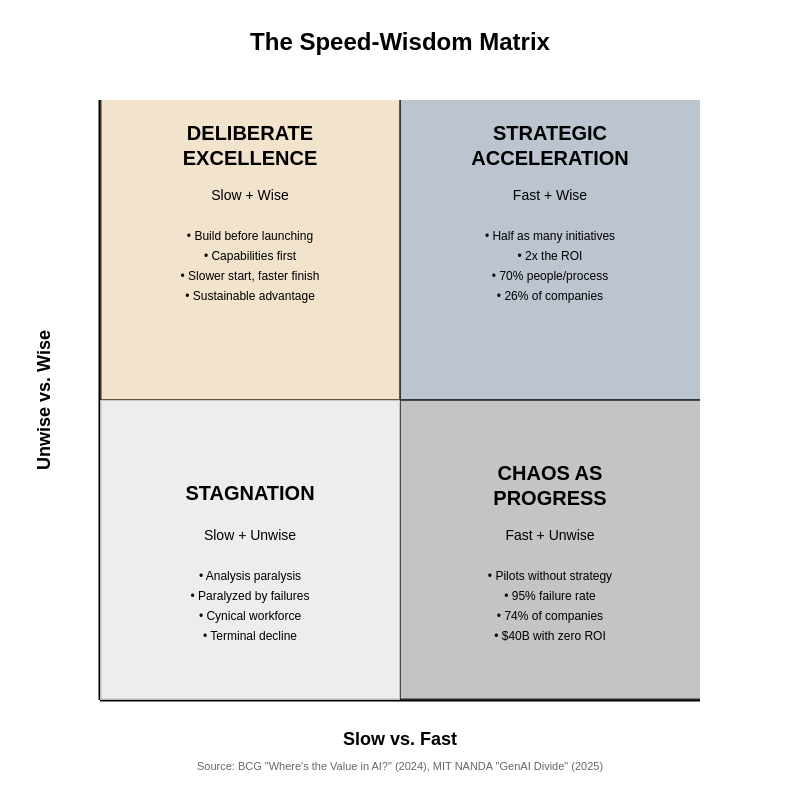
Figure 1. Speed-Wisdom Matrix (Credit: Nadir Ahmad/Dowling Street)
Strategic Acceleration (Fast + Wise) is where the AI leaders live. BCG found they pursue half as many opportunities as their peers but expect more than twice the ROI. They move fast where they have clarity and capability. They move deliberately everywhere else. Speed becomes a strategic choice, not a default mode.
Chaos Masquerading as Progress (Fast + Unwise) is where most organizations are trapped. Launching pilots without strategy. Adopting tools without training. It looks impressive in slide decks. It produces nothing in reality. The 95% failure rate lives here.
Deliberate Excellence (Slow + Wise) is the most underrated quadrant. Organizations here take time to understand problems before implementing solutions. They build capabilities before launching initiatives. They look slower at first. They finish faster in the end.
Stagnation (Slow + Unwise) is where velocity-addicted organizations end up once they burn through enough failed transformations. Paralyzed by past failures. Cynical about change. This is the long-term cost of moving too fast for too long.
Why the Winners Move Slower (Initially)
The AI leaders aren't lucky. They're disciplined. As I mentioned above, BCG's research found they follow a specific pattern: 10% to algorithms, 20% to technology and data, and 70% to people and processes.
That 70% is the work that feels slow. Building change management capabilities. Training employees. Redesigning workflows. Creating governance structures. Developing new performance metrics. None of this is glamorous. All of it is essential.
The companies that skip this work can launch faster. They just can't succeed.
There's a parallel in professional sports. Elite sprinters don't just train by running fast. They spend most of their time on strength training, flexibility work, technique refinement, and recovery. The speed is the outcome of the preparation, not a replacement for it.
Organizations have forgotten this. We've convinced ourselves that moving fast is the same as being prepared to move fast. It's not.
Four Disciplines for Strategic Velocity
So how do you move at the right speed? Four practices separate strategic acceleration from chaos.
Discipline 1: The Deliberation Ratio
For every hour you spend executing, spend 15 minutes in strategic reflection. Not planning the next action. Asking whether you're solving the right problem. Whether the current approach is working. Whether you're building capabilities or just checking boxes.
Discipline 2: The Half-Speed Principle
AI leaders pursue half as many opportunities as their peers. They're not less ambitious. They're more disciplined. Apply this broadly: What would happen if you launched half as many initiatives with twice the focus?
Discipline 3: The Integration Pause
Human systems need time to absorb change before they can handle more. After any major initiative, build in a deliberate pause for integration. A structured period where the focus shifts from launching new things to ensuring the last thing actually sticks.
Discipline 4: The Wisdom Audit
Every quarter, examine your major initiatives and ask: Are we moving fast because we're clear, or because we're anxious? Are we building capabilities, or just deploying technology? Will this create sustainable change, or just impressive optics?
A Practical Approach: The Wisdom Audit
Every quarter, examine your major initiatives and ask three questions:
Are we moving fast because we're clear, or because we're anxious?
Are we building capabilities, or just deploying technology?
Will this create sustainable change, or just impressive optics?
If you can't answer these questions with confidence, you're probably moving too fast.
The Real Test
AI adoption will be the defining test of this generation of leaders. Not because AI is uniquely difficult, but because it exposes a deeper dysfunction: our addiction to velocity over value.
The $30-40 billion that organizations have spent on AI with zero return isn't wasted potential. It's the cost of not understanding that transformation requires more than technology. It requires wisdom. It requires patience. It requires moving at the speed of human adaptation, not the speed of technological capability.
The leaders who figure this out won't just succeed with AI. They'll succeed at everything that comes after it. Because they'll have learned something that most of their peers are still running too fast to understand: sustainable change isn't about how quickly you can move. It's about how wisely you can move at the speed your organization can actually absorb.
The question isn't whether you should slow down. It's whether you're currently moving at a pace that serves your strategy or just serves your anxiety.
Most leaders won't like the answer. But the ones who are willing to ask it, and act on what they discover, will be the ones still standing when this current frenzy burns itself out.
Because in the end, the race doesn't go to the swift. It goes to those who understand that sometimes, the fastest way forward is to pause long enough to make sure you're actually heading in the right direction.
Sources:
MIT NANDA Initiative. "The GenAI Divide: State of AI in Business 2025." Massachusetts Institute of Technology, 2025.
Boston Consulting Group. "Where's the Value in AI?" BCG, October 2024.
Deloitte. "State of Generative AI in the Enterprise 2024." Deloitte Insights, 2024.
Sapolsky, Robert M. "Behave: The Biology of Humans at Our Best and Worst." Penguin Press, 2017.
What's the pace of change your organization can actually sustain? That might be the most important strategic question you're not asking.