
The Real System Running Your Org
By Jenny Vazquez-Newsum, Principal at Dowling Street
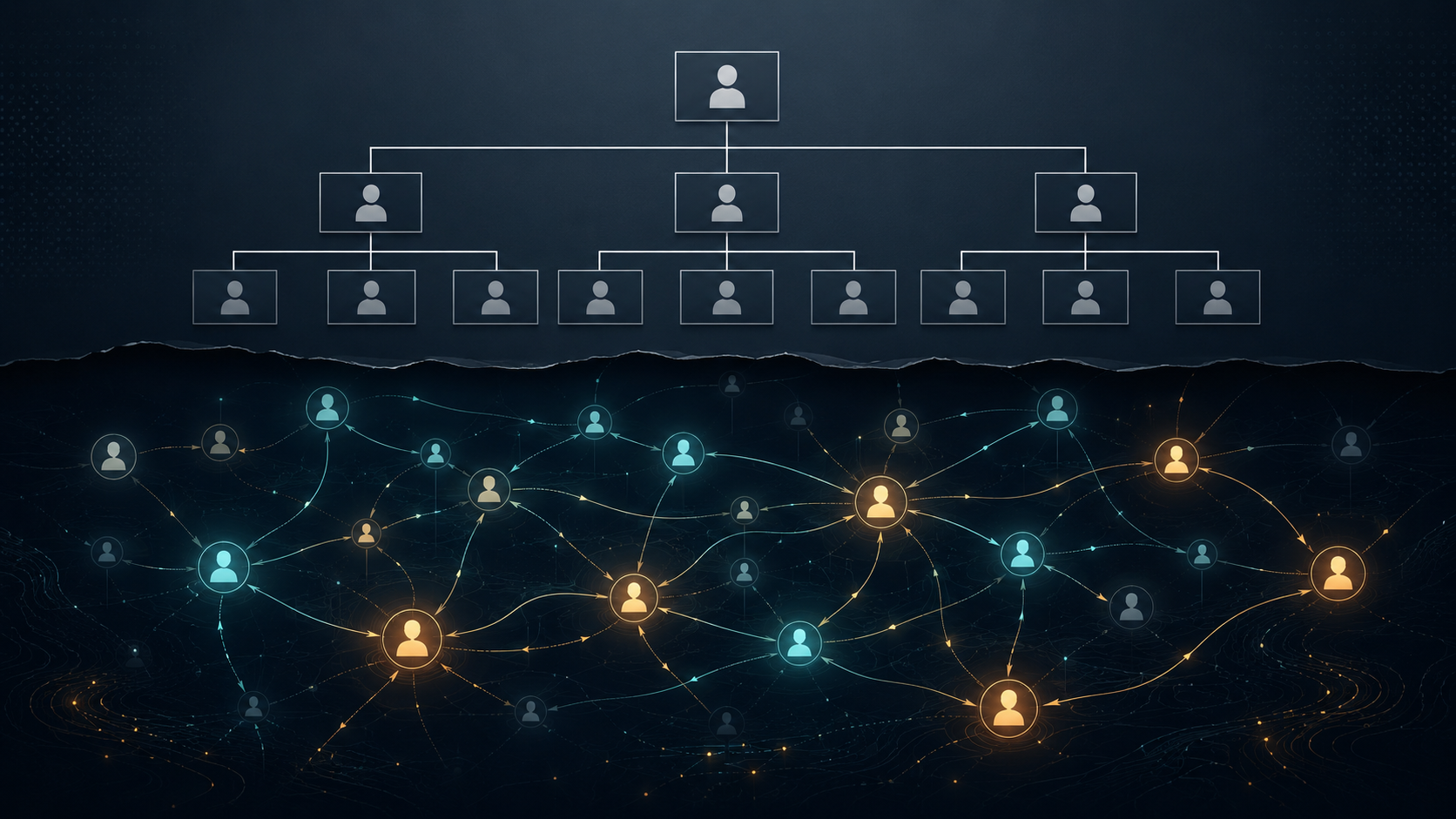
There's a second organization operating inside your first one. It doesn't appear on the org chart. It wasn't designed. It has no official authority. And yet it shapes which decisions actually stick, which ideas survive contact with the culture, and who really has power.
It’s a shadow system.
Every organization has one. It's the set of unwritten rules, informal networks, and unspoken agreements that run parallel to everything you've intentionally designed. The official organization lives in your org chart, your documented processes, your stated values. The shadow system lives in the conversations that happen before the meeting, in the people whose approval everyone seeks before anything moves, in the stories that travel through your culture teaching people what's actually safe here.
The Other Organization
Shadow systems aren't necessarily dysfunctional. They're adaptive. They emerge wherever formal structures fail to meet real human needs: the need for trust, for safety, for agency, for honest information. When a formal system can't deliver those things (or actively works against them) people don't stop needing them. They find another way.
The shadow system is that other way.
It shows up as the informal network that moves decisions forward, as opposed to the approval process that's supposed to. It shows up as the unspoken agreements about what can and cannot be said in a particular room, with a particular audience. It's the person without a senior title whose blessing everyone quietly seeks before anything new moves. It's the way work actually gets done, as opposed to the way the process document says it does.
This Is Older Than Your Organization
None of this is unique or even new. Some of the most consequential shadow systems in history operated just beneath the surface of institutions that believed, sincerely, that they were running themselves.
Franklin D. Roosevelt's inner circle offers one of the clearest examples. While his official Cabinet held formal authority, Roosevelt relied heavily on what became known as his "Brain Trust", a loose group of academics, advisors, and confidants who shaped New Deal policy largely outside official channels. The real deliberation happened before the formal decisions. The people with the titles weren't always the people with the influence. That gap between formal and actual authority didn't represent a failure of the institution. It represented how human beings navigate power when the official structure doesn't fully serve their needs.
Before labor unions had legal standing, workers developed intricate informal coordination systems. These included shared signals, trusted messengers and careful agreements that operated entirely outside official channels and were often more cohesive than the formal structures that eventually followed. When the formal system offers no safe path, people build their own.
The same dynamic plays out in every large organization today, in quieter but no less consequential ways. The formal process says decisions flow through this committee, this approval chain, this documented protocol. The shadow system says: find the three people whose alignment truly matters and have the real conversation before the meeting.
Neither is entirely wrong. But if you can only see one of them, you're only leading half the organization.
What the Org Chart Can't Answer
Every organization also carries something harder to map: a living mythology. A body of stories that travel through the culture. These manifest through onboarding conversations, through Slack channels, through the way senior people talk in unguarded moments. This is persistent organizational work long after their origin has been forgotten.
These stories answer the questions the org chart can't. What’s the consequence when you push back on a decision? What happens when you fail visibly? Who gets protected, and who gets sacrificed? How much of what leadership says can safely be trusted?
Think of the story in your organization that everyone knows. It’s the one that surfaces when someone is considering taking a risk, raising a concern, or trying something new. You probably know the one. It may be years old. The people involved may have long since left. But the story persists because it's doing a job: teaching people, reliably and efficiently, what can be trusted as safe here.
These stories function as living policy. They constrain behavior more reliably than any written guideline, precisely because no one officially sanctioned them. And because they're informal, they can't be challenged, updated, or repealed through any official channel. They simply circulate, accumulating authority with each retelling.
There are three questions worth asking about any story traveling through your organization:
1. Where did it come from?
2. Who does it serve?
3. And what is it teaching people about what's safe to do?
If you're not actively tending your organization's narrative, the narrative is managing you. And it may be telling people things you would never endorse, things about risk, about voice, about who this place is really for.
The Back of the T-Shirt
Stories travel because they fill a vacuum. And that vacuum is almost always made of the same material: things that cannot be said out loud.
Shadow systems grow in direct proportion to what's unsafe to surface. When people don't feel secure raising honest information through official channels, that information doesn't disappear. It goes underground. It moves through trusted relationships, coded language, and the kind of candor that only happens after the meeting is over and the cameras are off.
Organizational psychologist Amy Edmondson's research on psychological safety makes this dynamic explicit. Teams with low psychological safety don't stop noticing problems, they simply stop reporting them. The information still exists. It's just not flowing where leadership can see it.
This is where the concept of the "back of the t-shirt" becomes useful. The front is the LinkedIn profile: the credentials, the accomplishments, the official story. The back is what everyone in the room already knows but won't say directly to that person: the leadership blind spots, the open secrets, the feedback that never makes it through official channels. Most organizations are being run, in part, by the information on the back of the t-shirt: the unsaid assessments, the unacknowledged trade-offs, the quiet conclusions people have drawn about what's real here.
What lives on the back of the t-shirt doesn't stay still. It moves. It shapes how people interpret decisions, how they respond to change initiatives, how much they're willing to bring of themselves. And it rarely stays cleanly separate from the organization's formal functioning for long.
This is where Robert Kegan and Lisa Lahey's work on immunity to change becomes directly relevant. When leaders drive change and it doesn't stick, the default diagnosis is a skill gap or a motivation problem. But frequently, what's operating is something more structural: a competing commitment so entrenched it can't be named, because naming it would require an uncomfortable conversation about power, fear, or institutional trade-offs nobody wants to put on the table. The shadow system isn't resisting change out of stubbornness. It's protecting something it has learned through experience that needs protecting. Until that underlying dynamic is surfaced, no change initiative will hold.
The shadow system's immune response is where organizational change efforts begin their descent to falling flat.
What You Can't See Is Still Running
The cost of all this isn't just inefficiency. It accumulates in specific, compounding ways that are easy to misread.
Decisions that look made keep getting relitigated. A team agrees in the room and then quietly reinterprets, stalls, or routes around what was decided. This isn’t out of bad faith, but because the agreement was reached in the formal system while the resistance lives in the shadow one.
Talent that can read the shadow system accurately often leaves. The people with the clearest view of the gap between the official culture and the real one are frequently the people best positioned to make that judgment. When they conclude the navigation cost is too high, that the energy required to move through the shadow system is energy they'd rather spend elsewhere, they flee. And they rarely say exactly why.
Innovation dies in translation. A new idea enters the formal system getting approved, resourced, announced. And then encounters the shadow system's immune response: the subtle withdrawal of cooperation, the quiet wait-and-see, the organizational antibodies that were never visible in any official process. By the time leadership notices, the moment has passed.
Trust erodes from the bottom up. When people observe that the real rules and the stated rules are different — that what gets rewarded and what gets said are two different things — they don't simply disengage. They become cynical translators of everything leadership communicates. Every announcement gets processed through the shadow system's interpretive layer before it lands. And that layer is not neutral.
Shadow systems, in this sense, function like elevated blood pressure. There's no dramatic presenting symptom. The organization looks like it's functioning. But underneath, everything is being organized around a condition that's quietly shaping outcomes, narrowing options, and building toward something that will eventually be hard to ignore.
Reading the System You're Actually In
The goal isn't to eliminate the shadow system. I don’t think that is realistic. It won't survive that attempt, and the attempt itself will become its own cautionary tale. The goal is literacy. The ability to read the organization you're actually leading, not just the one you've designed.
A few questions worth sitting with:
Where does tacit resistance show up after apparent agreement? The gap between yes in the room and slow-walk in execution is the seam between your formal and shadow systems. It's a signal worth following rather than managing around.
What stories are traveling in your organization, and what are they teaching people about risk? If you don't know, that's meaningful data. It means the narrative has been running without you.
Who holds informal authority, and is it aligned or in tension with the formal structure? Misalignment here is one of the most reliable sources of "mysterious" execution failures. When informal and formal authority point in different directions, people navigate toward the one they trust. That's rarely the org chart.
What competing priorities in the room does no one name? These are the shadow commitments. The ones that explain why things that seem to be moving forward keep quietly stopping. Kegan and Lahey's framing is useful here: behind every stalled change is usually a competing commitment that the system is working just as hard to protect.
And perhaps most usefully: how are you contributing to the conditions that keep these systems underground? This is the hardest question, and the one most likely to produce something actionable.
We invest enormous energy designing formal systems. Org charts, strategies, processes, communications cascades. We document the way things are supposed to work and then are surprised, repeatedly, when something else is running.
But the shadow system isn't the anomaly. It's the honest record of what your organization has learned through accumulated experience about safety, power, and what's real. It is, in a sense, your organization's most accurate self-portrait.
The question isn't how to eliminate it. It's whether you have the literacy to read it. And the willingness to ask what it's been trying to tell you.
That second organization — it's been communicating all along.
Sources:
Edmondson, A. 1999. Psychological Safety and Learning Behavior in Work Teams. Administrative Science Quarterly, 44(2): 350–383. https://doi.org/10.2307/2666999.
Kegan, R., & Lahey, L.L. 2001. The Real Reason People Won't Change. Harvard Business Review, November 2001. https://hbr.org/2001/11/the-real-reason-people-wont-change.
Zani, M. 2021. The Science of Dream Teams: How Talent Optimization Can Drive Engagement, Productivity, and Happiness. McGraw-Hill.