
Why Busy People Aren't Making Progress

By Kristen Illes, Principal at Dowling Street
A few months ago, I sat in on a leadership offsite where a president told her team, "We need to be more strategic this year." Heads nodded. Someone wrote it on a whiteboard. The meeting moved on to a 45-minute debate about which project management tool to standardize on.
Nobody in that room was lazy or coasting. Every calendar was double-booked. Six months later, the "strategic" priority hadn't moved an inch. What had moved was everything else: three new dashboards, a reorganized reporting structure, two new Slack channels, an all-hands on operational excellence.
I see this pattern constantly: organizations working harder than ever and getting less real progress out of it. It looks like a productivity problem. It isn't. It's a diagnostic problem, and once you see it, it's hard to unsee.
Dru Armstrong, CEO of the fintech company AffiniPay, describes watching the same pattern from the inside: when she names a priority, the answer is often that the team is too busy. Her response has become a standing test question: "Busy doing what?"
The Diagnostic Error
Harvard's Ronald Heifetz, working with longtime collaborator Marty Linsky, spent decades studying why leadership efforts fail: the failure usually isn't one of effort or intelligence. It's a failure of diagnosis.
Heifetz and Linsky distinguish between two kinds of problems. Technical challenges have a clear definition and a known solution; they may require expertise, but the expertise already exists. Adaptive challenges are murkier: the problem is contested, no playbook applies, and solving it requires people to learn new skills or let go of something they value. Their diagnosis is blunt: leaders repeatedly treat adaptive challenges as if they were technical ones.
Most of what lands on a "strategic priorities" list is adaptive by nature: building trust across functions, changing who holds decision rights, shifting a culture that rewards busyness over judgment. None of these have a fix you can buy or hand to a single expert. They require learning. And learning is uncomfortable.
The Comfort Beneath the Error
Here's what I don't think gets said enough: leaders don't misdiagnose adaptive work as technical work by accident. It's the more comfortable mistake to make.
MIT's Edgar Schein spent his career studying why people resist change. He identified two competing anxieties: survival anxiety, the fear of what happens if you don't change, and learning anxiety, the fear of looking incompetent or being temporarily worse at your job before you're better at it. Real change only begins once survival anxiety outweighs learning anxiety, and most organizations have this backwards, manufacturing urgency instead of making it safe to be temporarily bad at something new.
Technical work protects you from learning anxiety: if you're the person with the answer, you stay the expert. Adaptive work asks you to admit, often in front of your team, that you don't know what to do yet. That's a genuinely uncomfortable position for anyone who was hired, promoted, or praised for having answers.
The culture doesn't help, either. Silvia Bellezza's research found busyness has become a status symbol: a packed calendar reads as scarcity and importance, not a warning sign. The leader who fills their week with visible activity isn't just avoiding discomfort. They're being rewarded for it.
The Expertise Trap
This dynamic sharpens the higher you go, because most leaders were promoted for the skill set that now works against them.
Roger Martin calls this the responsibility virus: a leader steps in to personally solve a problem that should belong to someone else's development, gets praised for the save, and the pattern repeats until it's simply how the team operates. It feels responsible. It's actually a quiet way of avoiding the slower work of building someone else's judgment.
A 2025 DDI study found fewer than one in five newly promoted leaders have the delegation skills the role requires; most were promoted for individual performance, then handed a job requiring the opposite skill: building others' competence instead of exercising their own.
So when a decision needs to be made, the manager uncomfortable with ambiguity does what got them promoted: solves it themselves, or escalates it. Both technical moves. What rarely happens is staying with the discomfort long enough to let someone else build the judgment to make that call.
Where It Shows Up: The 1:1 That Isn't One
You can see this compress into one familiar, weekly artifact: the 1:1.
A status-update 1:1 is technical: What did you finish? What's blocking you? Send me the file. It's efficient and feels productive, and develops almost nothing. A developmental 1:1 is adaptive: What are you learning? Where are you stuck? What decision can I hand you this week that I'd normally make myself? That version is slower, and far more likely to build the judgment the organization needs.
Gallup research shows how wide this gap is: managers account for at least 70% of the variance in team engagement scores, and only about one in ten people naturally have the traits of a great manager; just 18% of current managers demonstrate that level of talent. That gap shows up every week, in meetings that could be building decision-makers and instead are just clearing inboxes.
One related pattern: the manager who reclaims a decision after delegating it, or quietly redoes a team member's work instead of coaching it forward. The intent is usually good. The lesson is the same one busyness culture teaches everywhere: judgment isn't safe to exercise here, so stop trying.
A Framework: The Adaptive Avoidance Matrix
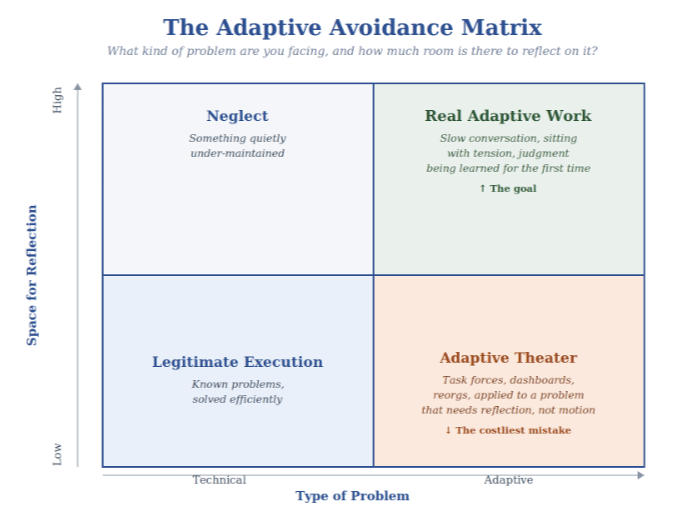
Figure 1. Adaptive Avoidance Matrix (Credit: Kristen Illes/Dowling Street)
Plot two questions against each other: what kind of problem are you facing, technical or adaptive, and how much visible activity surrounds it? Four patterns emerge (see Fig. 1).
Technical + High Activity is legitimate execution: known problems solved efficiently. Technical + Low Activity is neglect. Adaptive + High Activity is adaptive theater: task forces, workshops, dashboards, and reorgs applied to a problem that needs reflection, not motion, like speeding up one station on a factory line while the real bottleneck sits downstream, untouched. Adaptive + Low Activity is most often mistaken for stalling, but it's frequently the real work: the slow conversation, the decision someone is learning to make for the first time.
The costliest mistake I see leadership teams make is landing in that third quadrant and mistaking the busyness for progress.
Where to Start
A few starting points if this sounds like your organization:
1. Diagnose before you act. Before responding to any "strategic" problem, ask: is this a known problem with an available fix, or does it require learning something new? The answer should change your approach.
2. Say "I don't know yet" out loud. Normalizing not having the answer lowers the learning anxiety Schein describes, making it safer for teams to sit with ambiguity instead of resolving it prematurely.
3. Redesign the 1:1 around one question. "What decision can I hand you this week?" turns a routine check-in into a mechanism for building judgment, not just tracking tasks.
4. Reward the reasoning, not just the outcome. Recognize someone publicly for a well-reasoned decision even when it didn't land perfectly, or you'll train your best people to avoid the adaptive work that actually changes the organization.
Closing
None of this means busy is bad. Some problems genuinely are technical, and the fastest, most visible fix is the right one. The costly mistake isn't moving fast; it's mistaking motion for progress on a problem that was never going to be solved by moving faster.
So before your next planning cycle, ask a harder question than "what should we prioritize": how many of these things are actually asking us to learn something new, and are we willing to feel incompetent long enough to learn it?
This distinction shapes how we work at Dowling Street: in strategic planning, we push clients to name upfront which parts of a plan are technical and which are adaptive, since conflating them is where plans quietly stall; in executive and team coaching, we build leaders' tolerance for not-yet-knowing as much as we sharpen their expertise; and in training, we design around practice and discomfort rather than information delivery. The organizations that make real progress aren't the ones with the most activity. They're the ones willing to sit with the harder, slower work long enough to change something.
Sources:
Heifetz, Ronald A. Leadership Without Easy Answers. Belknap Press of Harvard University Press, 1994.
Heifetz, Ronald A., and Marty Linsky. Leadership on the Line: Staying Alive Through the Dangers of Leading. Harvard Business School Press, 2002. https://www.hks.harvard.edu/publications/leadership-line-staying-alive-through-dangers-change
Coutu, Diane, and Edgar H. Schein. "The Anxiety of Learning." Harvard Business Review, March 2002. https://hbr.org/2002/03/the-anxiety-of-learning
Bellezza, Silvia, Neeru Paharia, and Anat Keinan. "Conspicuous Consumption of Time: When Busyness and Lack of Leisure Time Become a Status Symbol." Journal of Consumer Research 44, no. 1 (2017): 118–138.
Waytz, Adam. "Beware a Culture of Busyness." Harvard Business Review, March–April 2023.
Martin, Roger. The Responsibility Virus: How Control Freaks, Shrinking Violets—and the Rest of Us—Can Harness the Power of True Partnership. Basic Books, 2002.
DDI. "Global Leadership Forecast 2025." Development Dimensions International, 2025. https://www.ddi.com/research/global-leadership-forecast-2025
Gallup. State of the American Manager: Analytics and Advice for Leaders. Gallup, 2015.